

Every November, South Korea grinds to a halt for its notorious college admissions test.
Stores close, flights are delayed to reduce noise, and the usual pace of the morning commute decelerates for the test-takers.
By late afternoon, the majority of examinees exit of school gates, breathing a sigh of relief and greeting the family members waiting outside.
However, some individuals concludes at that hour. Even once night has fallen and night has set in, certain test-takers are still in the testing hall – completing close to 22:00.
These are the visually impaired examinees, who often devote over half a day completing the most extended form of the Suneung.
The Endurance Test
This week, over half a million examinees across the country will take the Suneung – an abbreviation for College Scholastic Ability Test in the local language. This represents the largest figure of test-takers in seven years.
This examination not only dictates if people can go to university, but may influence their career opportunities, earnings, where they will live and even future relationships.
Depending on their subject choices, students complete roughly 200 questions across Korean, math, foreign language, social or natural sciences, second language, and Hanja.
For most students, this constitutes an eight-hour marathon of back-to-back tests. Starting the Suneung test at 8:40 AM and finish around 17:40.
Blind students with severe visual impairments, however, are allocated almost double the standard testing duration.
Consequently, when completing the additional foreign language section, the exam can finish as far as 21:48 – nearly thirteen hours after it started.
There is no dinner break; the exam proceeds uninterrupted.
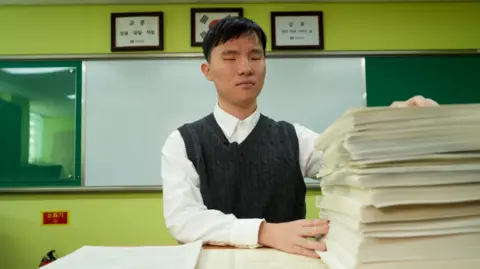
The physical bulk of the tactile examination materials also contributes to the length.
As each phrase, mark and diagram is converted into tactile writing, every exam document transforms into significantly more voluminous than the standard equivalent.
Student Perspectives
At Seoul Hanbit School for the Blind, teenage a student is among the examinees who are preparing for the longest version of the Suneung this year.
Last year, there were over a hundred visually impaired examinees across the country – ninety-nine with low vision and twelve with complete visual challenges like the student – according to data from educational authorities.
Dong-hyun was visually impaired from birth and cannot distinguish light.
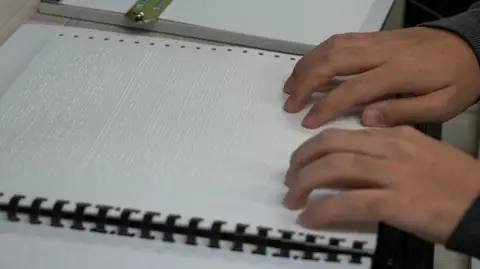
When meeting on campus, his hands moved rapidly across a braille practice booklet of past exam questions.
Approaching the examination date, he was focused on maintaining his stamina and condition. Dong-hyun will take the exam using tactile materials and a audio assistance device.
"It's really exhausting because the test duration is extensive," he mentioned. "However, no unique method exists. I just follow my study schedule and try to manage my condition. That's the only way."
Dong-hyun said the language component is especially challenging for him.
Regular examination materials for that section is approximately 16 sheets – but the tactile edition is roughly one hundred pages long.
Despite using screen-reading software, spoken information vanishes as immediately after it is perceived, contrary to text that can be viewed and re-read. He has to retain information in his recall as he goes.
The mathematics section is no easier.
He must interpret complex graphs and data sets that have been transformed into braille, solely through his touch.
Nevertheless, he observed that things are better than they were previously. In the past, students had to do almost all calculations in their heads. However, recently, blind test-takers have been allowed to use a tactile device, known as Hansone.
"Just like those with vision document their work in pencil, we enter them in braille on the device to follow the steps," he explained.

Physical Demands
Another student at the institution, 18-year-old Oh Jeong-won, who will likewise complete the exam currently, said the late afternoon are "the most difficult period" of the day.
"Up until lunch, it's tolerable," he stated. "However, during late afternoon, after English and prior to history, that period it gets really tough.
"Without an evening meal," he explained. "We continue answering questions while we would normally eat, so it feels even more exhausting. Nevertheless, I keep going because I understand there will be a feeling of achievement at the end."
For the student, the fatigue is intensified by the necessity to stay intensely focused with both his hands and his auditory perception.
"While processing the tactile information with my hands and simultaneously receiving content through audio, it seems much more tiring than it does for sighted students," he described.
Study Challenges
However, examinees say that the length of the exam and the extended preparation are not the hardest part. What is most challenging is access to learning resources.
Common educational materials and digital classes that those with vision rely on are frequently inaccessible.
Limited numbers of tactile editions, and converting materials into sound needs having text files – which are difficult to obtain. In many cases, someone has to personally input entire workbooks to make them usable.
Online lectures present additional challenges, as many instructors explain concepts using visual notes, diagrams and images on display, which cannot be followed through audio alone.
One of the most significant barriers, though, is the delay in obtaining braille versions of the state-produced EBS preparation books – a core set of resources directly connected to the standardized test.
Due to this postponement, visually impaired examinees often receive the materials months later than others.
"Sighted students receive materials between January and March and use them for the entire period," said Jeong-won. "We obtain the tactile materials approximately in August or September, when the exam is just a few months away."
Dong-hyun expressed the identical worry.
"The braille materials weren't completed until less than 90 days prior to testing," he said. "I consistently hoped the production timeline could be faster."
The National Institute of Special Education, which produces the braille version of EBS exam materials, stated that the procedure takes at least 90 days for every volume because it must follow specific regulations.
The organization added that it is "implementing multiple initiatives to guarantee that blind students can learn uninterrupted, including creating and providing the materials in separate volumes."
An advocacy group indicated it has long raised these concerns with {author


